Hi FOFOA,
Here's a snippet from Once Upon a TIme you will no doubt recall:
"The ECB, on the other hand, is not mandated to assist the economy like the Fed is."
On the surface that condition might seem to contradict my view about monetary systems, namely that monetary systems must ensure that essential economic activity is facilitated or they will be discarded, but the price stability mandate, while not directly supportive of key economic activity can hardly be said to be antithetical to it either, wouldn't you say?
In any case, perhaps my view should be modified such that it posits that monetary regimes do not need to directly facilitate essential economic activity to survive, it is sufficient that they foster an environment (such as organic price stability) that does not in any way impair or interfere with essential economic enterprise.
Cheers,
Edwardo
Hello Edwardo,
I think that "price stability" is a little bit of a misnomer that leads to the fallacy that changing or fluctuating prices are undesirable. Prices change relative to each other. It's what they do. It's their very purpose in life. It's just that prices shouldn't change due to currency effects. A currency needs to be independent of any special interest groups (e.g. the government) in order to function properly for the whole economy. And that proper function is the transmission of fluctuating price signals that allow the Superorganism to be as efficient as possible.
"Price stability" really means currency stability. Relatively stable against a broad basket of fluctuating prices so as to show that the price changes are not due to currency abuse, as well as stable against the currencies used by trading partners. I don't think it's really a goal of any hypothetically perfect currency to eliminate the price volatility in individual goods and services that transmits vital economic signals, even though that seems to be the goal of central planners.
When you give a central planner the mandate of assisting the economy, all this really means is that the central planner is allowed to pick winners and losers. This actually strangles an economy, so while in the short run it seems altruistic to not let the losers fail, the tradeoff is that you must also suppress the success of the winners. This leads to a society like today where the most parasitic members live high on the hog while systemically stifling true innovation. But I know you already know this. ;D
Sincerely,
FOFOA
For the purposes of my talk do you feel the following is valid? You will no doubt notice the modifications to the original.
Without over simplifying matters, whatever one thinks characterizes the state of play in monetary affairs writ large, it is imperative to understand that the preferences of the planet's most essential economic actors, entities that folks on FOFOA's blog often refer to as "Super Producers", at all times, despite any occasional appearances to the contrary, unerringly determine the fate of monetary regimes. The tail does not wag the dog, though in the world we live in it can sometimes appear that way. The fact is that however long a distortion may persist, monetary regimes only survive to the extent that they do not impair or interfere with the most critical productive enterprises of the economy. Monetary regimes that do not fulfill this function on behalf of indispensable productive enterprises can be expected to be under the sort of constant threat that is ultimately fatal. This concept/idea is implicit in the conceptual framework known as freegold which presents a very clear picture of the $IMFS maintaining its shaky position (for as long as it has) as the result of managing to “keep the gold flowing” in sufficient quantities at acceptable prices to Giants, who are defined, for the most part, as foreign oil producers after the collapse of Bretton Woods.
The dollar’s managers were enabled in their monetary system saving endeavors, because the rest of the world, had no choice as there was no other currency system around that could function in the wake of a $IMFS collapse.
Yes, that's good. And what was this necessary function you mentioned?
"there was no other currency system around that could function in the wake of an $IMFS collapse."
I said it in the email above: "And that proper function is the transmission of price signals that allow the Superorganism to be as efficient as possible."
If we had lost the $IMFS in 1979 what we would really have lost was the shared knowledge of the relative prices of everything real, like man losing his common language in the Tower of Babel story.
So you see, the $IMFS in 1979 represented that regressive link that keeps prices correlated so that they don't change dramatically in isolation. It also represents the markets in which traders act as the Superoganism's price transmission mechanism. To lose the $ would have been to lose that regressive link as well as the markets that keep it intact.
Oil would have had no choice but to bid directly for physical gold which would have driven gold to the moon and made oil very cheap for anyone with some gold. There would have been no markets for the traders to keep silver, copper, oil and gold all correlated, because the markets would have been destroyed along with the price information.
What we see in Freegold is this same outcome with regard to oil and gold, but without the disruptive chaos of having to start from scratch developing a new regressive link and building new markets. Europe has no problem with high priced gold and cheap oil. Losing the $ and/or the paper gold market will break those regressive links—oil and gold—but thanks to the euro, the rest will remain intact.
Hi FOFOA,
I just got off the phone with Bob English. I think we should Skype or talk by phone about it. In the meantime what evidence, and it doesn't need to be hard evidence like cables and such-though that would be helpful- do we have, for example, that Paul Volcker was told in no uncertain terms by his European counterparts that he needed to defend the dollar in the way that he ultimately did? Bob brought up Basel III which apparently makes provisions for the use of sovereign debt as a means to increase capital ratios. In any case, it was something that was sovereign debt friendly and he asked how Basel III framework fit in the with freegold thesis. Any guidance on this would be helpful. I'll tell you more when we speak.
Cheers,
Edwardo
"In the meantime what evidence, and it doesn't need to be hard evidence like cables and such-though that would be helpful- do we have, for example, that Paul Volcker was told in no uncertain terms by his European counterparts that he needed to defend the dollar in the way that he ultimately did?"
Okay, there are a few different pdfs around, mostly academic papers, that discuss this 1979 Volcker confrontation. But here's one hosted by the Fed itself! It seems pretty good and covers a lot of the detail. I highlighted the part about "stern warnings." Also, notice how fast it all goes down.
www.federalreserve.gov/pubs/feds/2005/200502/200502pap.pdf
The Reform of October 1979: How It Happened and Why
Page 19 –
On September 29, Chairman Volcker left for the annual International Monetary Fund (IMF) meeting, which was in Belgrade that year.6 On the plane flight to Europe, the Chairman took the opportunity to brief two top administration officials, G. William Miller, who was now Secretary of the Treasury, and Charles Schultze, chairman of the Council of Economic Advisors. They were not enthused with the idea of new procedures, and in coming days they made their solidifying views known to Volcker. Moreover, in their subsequent conversations with President Jimmy Carter, the President may have voiced similar concerns to them. But Chairman Volcker considered it significant that the President never directly expressed this disapproval to him in person or otherwise (Volcker and Gyohten, 1992, pp. 168-69).
On his trip abroad, Chairman Volcker also sought the counsel of various trusted foreign leaders and central bankers, including Germany’s Helmut Schmidt and Otmar Emminger. Their comments only reinforced his intention to move ahead. When his participation was no longer required at the IMF meetings, he returned early to the United States (Volcker and Gyohten, 1992, p. 168).
Chairman Volcker arrived in Washington on Tuesday, October 2, with his ears still resonating with strongly stated European recommendations for stern action to stem severe dollar weakness on exchange markets. His unexpectedly early return fueled market rumors that action dealing with the crisis might be imminent. This had a stabilizing effect on commodities markets, with futures markets opening lower on October 3, retracing some of their sharp increases on the previous several days (Figure 4).
The next regularly scheduled meeting of the FOMC was to take place on October 16, 1979, two weeks after Volcker’s return from Europe. However, and likely in light of the urgency of the situation after September 18, the Chairman instead decided to convene a special FOMC meeting earlier in the month. The special meeting, scheduled in secret and on very short notice, was to take place on Saturday, October 6, in Washington.
Little new governmental data was released in the three weeks after September 18 that could have provoked a sense of urgency about significant policy action. Table 1, reproduced from the Greenbook from October 12, 1979, shows the dating of various statistical releases tracked by the staff between September 18 and October 5. The only data published after that starting date but before Volcker left for Belgrade were for the consumer price index (CPI) and housing starts in August. To be sure, the annualized one month core CPI inflation rate in August exceeded 12 percent, up substantially from the 8.7 percent July core CPI inflation rate available at the September FOMC meeting. But this information, while unpleasant, did not seem to be the source of the alarm, as shall be seen from Chairman Volcker’s interpretation of these figures on October 6.
In the morning of Thursday, October 4, two days before the planned Saturday meeting, the Board met in its Special Library to discuss the possible monetary policy actions under consideration. According to the Minutes of the meeting:
[O]ne member of the Board referred to the outburst of speculative activity in the gold market, which appeared to be spilling over into other commodity markets as well, and to the very sensitive conditions in domestic financial and dollar exchange markets. He also noted that inflationary sentiment appeared to be intensifying as data on price increases continued to worsen. Against this background, the staff had been directed to prepare memoranda on a package of possible actions designed to show convincingly the Federal Reserve’s resolve to contain monetary and credit expansion in the U.S., to help curb emerging speculative excesses, and thereby to dampen inflationary forces and lend support to the dollar in foreign exchange markets. Such a package might include actions on reserve requirements and the discount rate; in addition, the staff had been asked to analyze the implications of a possible shift in Federal Open Market Committee procedures, whereby the Desk, in its day-to-day operations, would operate more directly on a bank reserves, rather than a Federal funds rate, target. (BOG Minutes, 10/4/1979, p. 1-2)
The Minutes indicate that “Board members agreed on the seriousness of the situation and on the need for action,” but postponed taking decisions on reserve requirements and the discount rate until Saturday, when the special FOMC meeting was to be held (BOG Minutes, 10/4/1979, p. 2-4).
[…]
On Basel III…
One potential line of attack (if someone were planning to attack Freegold) would be to start throwing out questions like "how does Basel III fit into the freegold thesis?" Even if you answered that one well enough, they'd eventually catch you with something you don't know enough about and then say, "a ha, so you haven't really considered such-n-such."
First of all, Basel III is about the commercial banking system, trying to make it more resilient and less prone to collapse. What does this have to do with Freegold? Not much.
You may recall that I have resisted attempts to steer the Freegold discussion toward advocating specific reforms for the commercial banking sector. To be sure, the banks have done plenty wrong. But the modern banking model itself is not the fundamental cause of the problems. In my view, there is nothing fundamentally wrong with the modern banking model. Some of the effects of the core problem that we've seen over the last two decades make the banks look pretty bad, but you've got to understand that Freegold fixes things at the foundation. Those symptoms will no longer exist when the banks don't have massive pools of savings to churn.
Basel III is about capital adequacy in the banking system, making banks stronger and less prone to collapse. Let's look at some of the reasons why this is more or less irrelevant to Freegold.
In Freegold, I don't expect commercial banks to hold physical gold as a reserve asset. Banks hold debt (promissory notes) as assets and base money as reserves. That's what banks do. Central banks hold physical gold as a reserve asset so the commercial banks' reserves (base money) have the reserve asset gold behind them at the CB level. This is the gold link in the banking system. Commercial banks will have little to do with gold except for maybe storing it and selling it as a retail dealer would. I do not expect to see gold on a commercial bank's balance sheet, but that doesn't mean a small bank here or there won't have some. I just don't expect it to be a systemic thing.
So banks hold debt. That's what they do. That's what they were designed to do. And that's what they do less of today than they should be doing, because today they earn so little interest on debt that they prefer to slice and dice it, package it up and sell it to savers, churning a profit off of the savers.
Banks are lending institutions. They are the one entity we would expect to hold debt, so that the rest of us can hold a true wealth reserve as savings. Furthermore, sovereign debt is not going to disappear altogether just because it has been discredited as the SoV par excellence. It's just not going to get out of control the way it has in the last couple of decades.
There is nothing in Basel III that I can see that is incompatible with Freegold. It would be silly to imagine that the Basel Committee on Banking Supervision would be secret Freegold insiders like A/FOA and friends, perfectly sculpting this bureaucratic document into a Freegold masterpiece. For example, all of the talk about gold as a tier 1 asset has nothing to do with Freegold. It has precisely everything to do with the BBs' fractional reserve gold banking practice, which will be gone come Freegold. It has to do with risk weighting their physical gold reserves the same as cash. It makes perfect sense. If you have a liability denominated in gold, then any gold you have as a reserve behind that liability should have a 0% risk weighting just like cash standing behind a cash liability. The BBs petitioned for "Tier 1 gold" because it would make their compliance with other new capital rules easier. But it has nothing to do with Freegold, and it will be rendered irrelevant come Freegold.
So I hope you can see, Edwardo, how Basel III is more or less irrelevant to Freegold. And if Basel III appears friendly to sovereign debt, that is no more relevant than it appearing friendly to bullion banks' fractional gold reserves.
Basel III is all about the commercial banks. Commercial banking will continue in Freegold, and will have little to do with the gold aspect. Physical gold in Freegold is primarily held by Central Banks and by savers. Banks get less of the savers money to churn and skim, and so they get back to their original purpose of lending and facilitating transactions.
Try not to get dragged into irrelevant discussions.
Sincerely,
FOFOA
Muy bien, gracias. Now, I've done some research on gold for oil and I've seen the Wikileaks cables where gold for oil is mentioned, what documents are you aware of that make the oil for gold state of affairs plain?
Thanks,
Edwardo
Re: Gold for Oil
Remember this?

US Mints ‘Gold Disks’ for Oil Payments to Saudi Arabia
The modern oil era really began in the mid-40s. It began with the US oil companies partnering up with the Saudis. The Saudis had the oil, but they were still living in the dark ages. We had the technology to get that oil out of the ground. So we teamed up and created Saudi Aramco. And from the beginning, they wanted some portion of the payment in gold.
I think that's a good place to start.
Yeah, I've already looked it over. Have we got anything else?
"Have we got anything else?" Re: Gold for Oil
It was common knowledge, at least in the 70s and 80s, that Middle Eastern oil interests liked their gold. A statement like that can disarm anyone who's trying to project their own doubt upon objective reality. I'll give you a few newspaper clippings to prove my point. Here's a snip from a New York Times article from March 27, 1991. Ignore the flawed MSM analysis, but notice that it was just an accepted fact that oil likes gold:

Notice here that it's just a given, even to the NY Times, that Middle East oil-exporting countries preferred gold to dollars and other paper investments. This was 1991. It was common knowledge. The article itself was about a recent decline in the PoG and the rumors were attributing the plunge to the Saudi Monetary Authority selling a bunch of gold. The Saudis later denied the rumor, but I think it could be a little more complex than that.
They could have been selling paper gold while still taking physical off the market via the subterranean flow. The purported Saudi "sale" was not a short sale, which means it was "gold" (paper gold) they had previously purchased, not borrowed. So perhaps the Saudis would buy paper gold to "lock in the price" and then once they had someone willing to sell them the physical, they would unwind that paper "hedge" and sell the paper. So even as it looked like they were selling and causing the price to decline, they could have in fact been taking delivery of physical and the paper "selling" was just the visible "symptom" of that action. Here's the Saudi denial from an article 4 days later:

Here's an MSM article from January 7, 1985 tying gold to oil. Again, ignore the flawed analysis, but pay attention to the common knowledge that the price of oil was tied to the gold market because the Saudis liked to use their profits to buy gold:

Here's a snip from the NY Times on July 28, 1972 about oil for gold:

Here's one from 10/13/73:

3/1/74:

12/14/79:

1/7/75:


It goes on and on…
_____________________
Unambiguous Wealth
From Unambiguous Wealth, here's 'Little Acorns' from the White Stripes. If you want to be truly prepared for the winter you need to be like the squirrel, taking little acorns, one at a time, back to your nest:
Fallacies – 1. Paper Gold is just like Paper Anything
"…it is the very existence of the paper gold market which is keeping the price too low, because if you took it away, price alone would have to regulate the flow."
From Fallacies, here's Million Pieces (Song for the Savers) from Freegoldtube. The "Lookout Guide" image on the video is from an interview I gave to a newspaper in India:
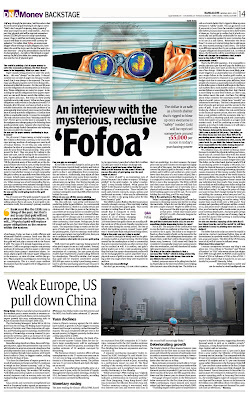
You can read the interview here.